
GeomVLA: Unifying Scene, Motion, and Action in 3D

Abstract
We present GeomVLA, a Vision-Language-Action model that unifies perception, latent scene motion prediction, and action generation within a shared 3D coordinate frame. Our approach lifts VLM features into spatially grounded 3D scene tokens by adjusting their positional encodings while preserving pretrained visual-language priors. We further introduce a 3D Scene Trajectory Denoiser, a task-conditioned latent motion representation that captures how scene points are expected to move in 3D space. The predicted scene trajectory acts as a latent geometric reasoning process that conditions a 3D flow-based action denoiser through 3D-aware attention.
GeomVLA achieves state-of-the-art performance on CALVIN, strong performance on LIBERO and RoboTwin2.0, and outperforms strong baselines in real-world manipulation settings without large-scale robot-action pretraining. Extensive ablations demonstrate that future-motion reasoning alone is insufficient: the primary gains arise from maintaining geometric consistency between scene representation, motion prediction, and robot actions throughout the entire perception-to-action pipeline.
Method

Scene Trajectory Prediction
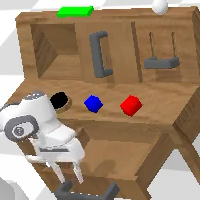
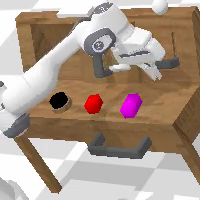
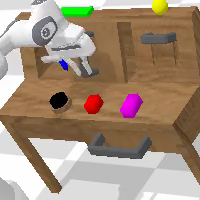
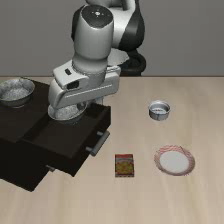
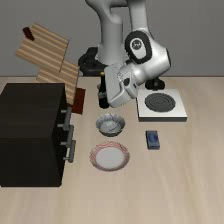
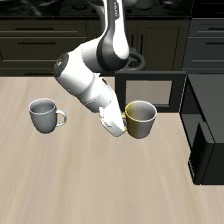
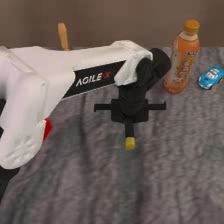
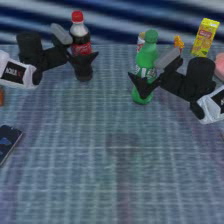
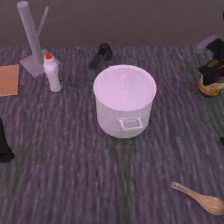
Simulation Rollouts
Real-world Deployment
Quantitative Results
table/graph for sim and real-world
Ablations
table/graph for key ablations
BibTeX
If you find this work useful, please consider citing our paper:
@misc{xiong2026geomvla, author = "{Ziyin Xiong, TODO}", title = "GeomVLA: Unifying Scene, Motion, and Action in 3D", year = "2026", howpublished = "\url{TODO}",}