Ziyin Xiong
熊梓因 · Robotics Institute, Carnegie Mellon University

I am a second-year MS Robotics student at the Robotics Institute, Carnegie Mellon University, advised by Prof. Katerina Fragkiadaki. I build robots that can act with dexterity and reliability in changing environments. My research focuses on physically grounded multimodal representations and scalable learning through interaction.
I received my Bachelor’s degree in Artificial Intelligence from Tong Class at Yuanpei College, Peking University, advised by Prof. Yixin Zhu. I also collaborated with Dr. Siyuan Huang and Dr. Tengyu Liu at BIGAI, and Prof. Masayoshi Tomizuka at University of California, Berkeley.
PhD applications: I am applying for programs starting in Fall 2027 and would be glad to connect about potential opportunities!
news
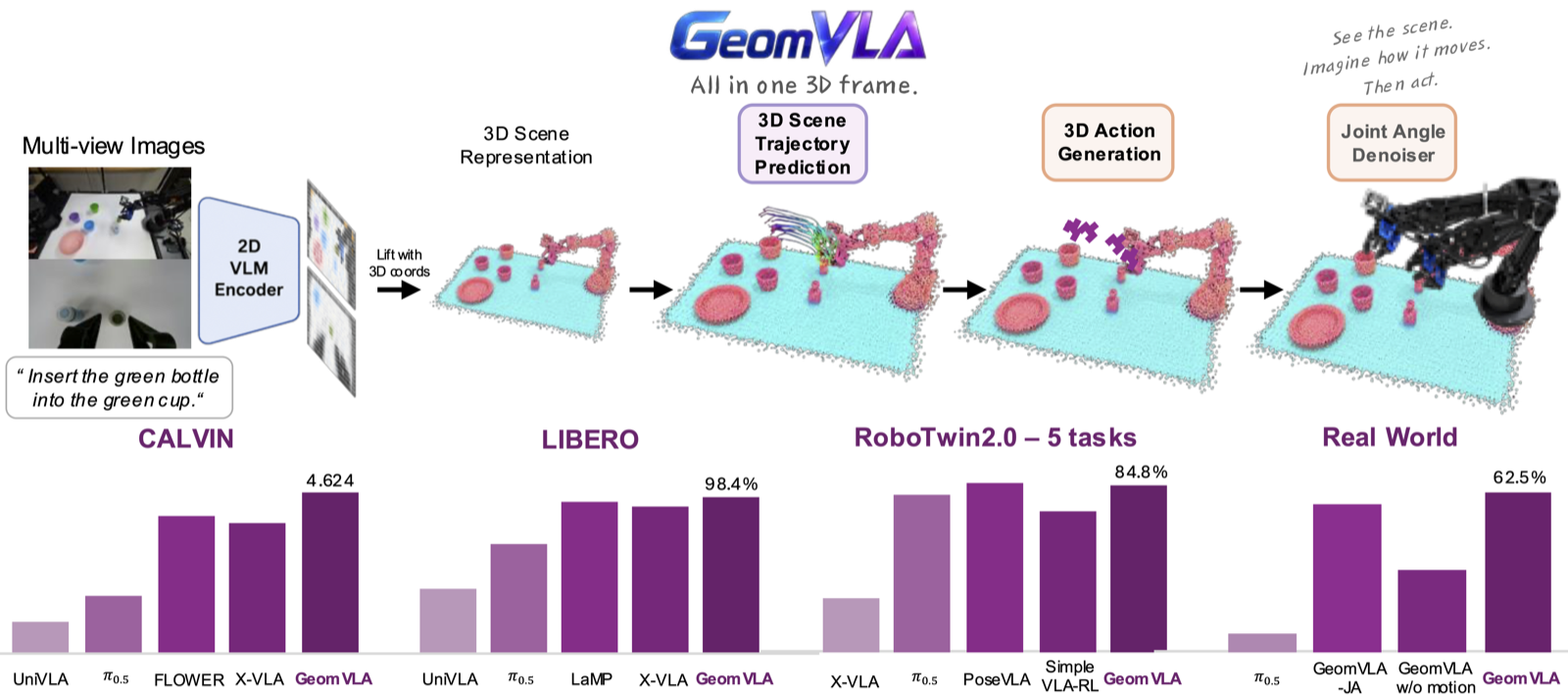
| Sep 2026 | Our work GeomVLA was accepted to CoRL 2026. |
|---|---|
| Jul 2026 | Our work Decomposing VAM Uncertainty was accepted to the Rethinking Safety Workshop and selected for an oral presentation at the Trustworthy Embodied Foundation Models Workshop at RSS 2026. |
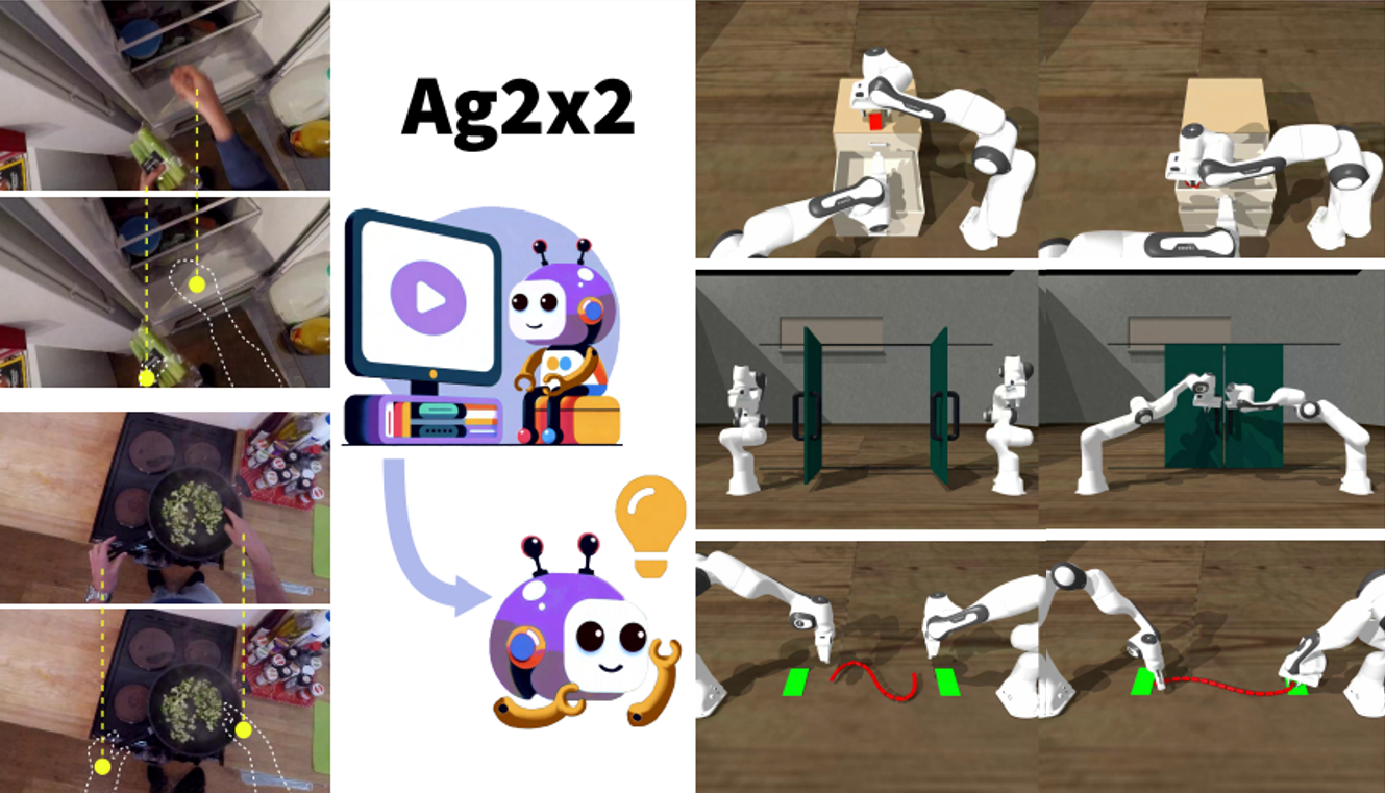
| Oct 2025 | Delivered an IROS 2025 talk on Ag2x2. |
Research
My goal is to build robots that are useful in everyday life, acting with dexterity, efficiency, and reliability in complex, changing environments.
Large-scale data has driven remarkable progress in robot learning. My research asks how robots can make the most of it: developing physical understanding that keeps fine-grained actions robust, and reasoning that transfers to new tasks.
Physically Grounded Multimodal Representations
Effective dexterous manipulation requires understanding scene geometry and the dynamics of physical contact. I study how visual, geometric, and tactile information can be coherently integrated to connect perception, prediction, and action, enabling robots to anticipate and control their interactions with the world.
Scaling Reasoning And Learning Through Interaction
I aim to scale robots’ ability to solve novel tasks while reducing reliance on exhaustive demonstration coverage. I am interested in how foundation-model reasoning can guide planning and exploration, while reinforcement learning enables improvement through experience. Simulation supports scalable interaction, complemented by real-world feedback for adaptation and transfer.